
'/%3e%3cdefs%3e%3clinearGradient%20id='prefix__paint0_linear_4737_37157'%20x1='3.018'%20y1='23.6'%20x2='44.925'%20y2='24.977'%20gradientUnits='userSpaceOnUse'%3e%3cstop%20stop-color='%231CB7FF'/%3e%3cstop%20offset='.502'%20stop-color='%232FF58B'/%3e%3c/linearGradient%3e%3c/defs%3e%3c/svg%3e)


Premier League manager rankings: Is Michael Carrick doing an even worse job than Roberto De Zerbi?
Sep 24 2026 10:19 · By onefootball.com · 6 Reads


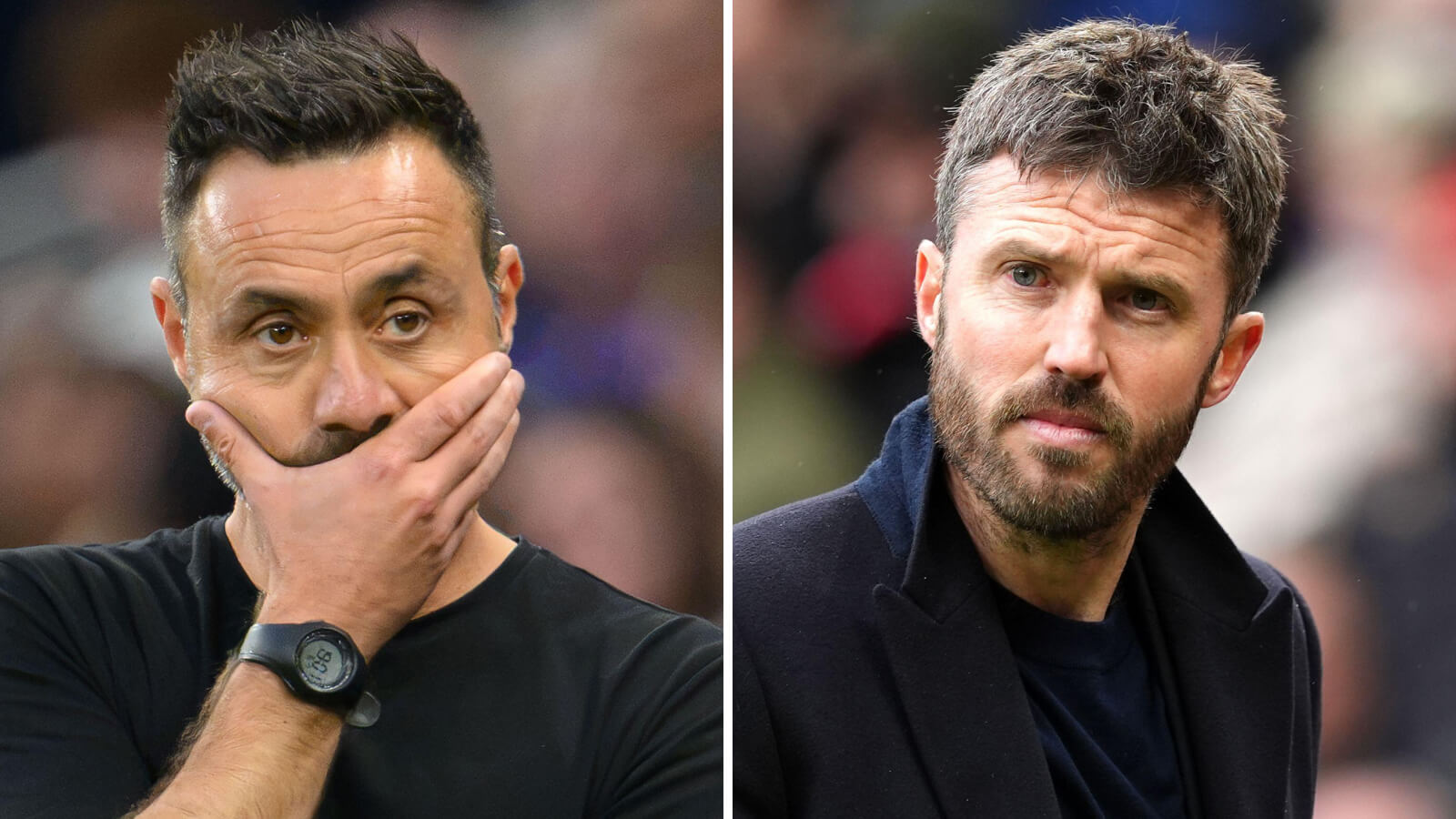
It’s the international break, and that obviously means we have quite literally no choice at all but to rank all the Premier League managers based on highly scientific criteria such as gut feel, hunches, vibes and, to a lesser extent, football results.
At least this first instalment of the season comes with the bonus of containing the bare-minimum 20 names. We’re absolutely certain that won’t be the case when we revisit this later on in the season. We’re already steaming headlong towards a post-lull El Sackico.
And let’s not kid ourselves, by ‘later on in the season’ we obviously mean the November international break and its inevitable content wasteland. Enjoy.
20) Michael Carrick (Manchester United) In his first 22 games since returning to the Manchester United hotseat on a permanent-interim and now interim-permanent basis (ignoring as we must the interim-interim spell he had in charge because it was ages ago) Carrick has amassed more points than Jurgen Klopp, Mikel Arteta or Pep Guardiola managed in their first 22 games at Liverpool, Arsenal and Manchester City.
As well as exposing that trio as obvious frauds and charlatans, that surely means Carrick deserves and must be given time to turn around his woeful start to this season, doesn’t it?
It sounds reasonable enough. But it’s not and he shouldn’t. It may seem just absurdly stupid, cruel, unfair and unreasonable to simply dismiss out of hand his first 17 games as United manager because they were played in unrealistic and unsustainable easy mode, but we must simply dismiss out of hand his first 17 games as United manager because they were played in unrealistic and unsustainable easy mode.
Carrick’s key tactic for the second half of last season was the football equivalent of pressing Up, Up, Down, Down, Left, Right, Left, Right, B, A, Start before every game. You simply cannot judge the efficacy and sustainability of a Manchester United manager on a period of time in which he was able to select Luke Shaw for every single game. It’s just patently absurd and not the real world.
We’re being facetious of course. But only a bit. Carrick just doesn’t have ‘it’. The sheer scale of United’s post-Amorim improvement was a surprise, and Carrick gets credit for it, but there was always likely to be a huge new manager bounce there.
For all his ‘manager on the field’ and ‘Club DNA’ credentials from his playing days, if you try to pin down Carrick’s best and most defining quality during his time as Man United manager it still feels like the answer is ‘He’s not Ruben Amorim’. And there are quite literally billions of Not Ruben Amorims out there.
Sure, some of those Not Ruben Amorims are Erik Ten Hag or Thomas Frank or Russell Martin. You could get unlucky. But does anyone still really believe with their whole heart that Michael Carrick is the absolute best Not Ruben Amorim United could have?
19) Roberto De Zerbi (Tottenham) It’s not entirely his fault, is it?
That’s the first and important thing to say about Roberto De Zerbi. Success has many fathers, failure is an orphan and all that.
Spurs’ is a failure with more fathers than it is possible to count. Some are still at the club. Many are not. Among their number are players, suits and, yes, multiple former managers.
Ange Postecoglou’s understandable prioritisation of the Europa League in 2025 had the unfortunate consequence of normalising Premier League defeats to an unhinged degree. Thomas Frank did absolutely nothing to address that, meaning that by the time De Zerbi arrived in North London a rot that had started during the boardroom complacency of the late Pochettino years had entirely taken hold. Normalised became simply normal.
And that’s without even really getting into the various catastrophic decisions made at boardroom level, or by the vast assortment of managers of every stripe who preceded that pair, or to excuse the players themselves, old and new, from their own pitiful, error-strewn under-performance.
But it does feel like Spurs’ current mess has to be considered chiefly a failure of management. And right now De Zerbi is not shifting the needle.
And the really interesting thing about this is that last season he decidedly was able to do so. He shifted the needle decisively and (necessarily) quickly, with what was on paper a far worse squad than the expensively assembled collection of players from his own wish-list now at his disposal.
How did he do this? Pragmatism and man-management. De Zerbi’s smartest and most significant decision when he took the job amid the desperate urgency of last spring was to realise he couldn’t perform the complicated surgery Spurs required – not yet, anyway – and that he would have to find a practical route through the maze even if that came at the expense of some of his core principles.
And that’s what he did. He put arms round shoulders. He convinced players who were no longer at all convinced of the fact that they were good at football. He found a messy but just-about-effective-enough and above all else deliverable halfway house between Frank’s passive, pathetic miseryball and his own high-energy game.
He didn’t get everything he wanted in the summer. But he got damn close to it. Closer, certainly, than anyone could have expected when Spurs scraped home in 17th on the back of a fraught 1-0 win over Everton on the final day.
It remains their most recent Premier League victory. It remains their only home Premier League win this calendar year. They have, and this feels a genuinely insane thing to be able to type, gone backwards.
This version of De Zerbi’s Spurs, with his players and after what was in theory a full pre-season, looks more like the worst of Frank’s team.
What we’re seeing is what Mourinho and Conte’s Spurs teams would have looked like without the twin cheat codes of Harry Kane and Son Heung-min.
How much of it is down to De Zerbi, we won’t know until it all comes out in the wash, but what’s clear from watching Spurs is the fear. De Zerbi himself spoke of fragility, which is also accurate. But we think fear is the better word. Fear and resignation.
Spurs are fragile, but those are the two reasons why they’re fragile. They’re afraid of their own shadows, and once hit with any kind of setback are immediately resigned to their fate. De Zerbi moans about this, but has so far been entirely unable to correct it.
It is so hardwired into Spurs that even the new players have succumbed instantly and entirely to it. Andy Robertson keeping the ball in to set up Villa’s equaliser while Spurs were down to 10 men was a cry for help.
That was an individual brainfart that can exist only in the midst of a collective fog brought about by the fear. Spurs are a self-fulfilling catastrophe.
But that’s for De Zerbi to solve, and he hasn’t scratched the surface of it. All these issues predate him, but none have improved under him. Spurs haven’t won any of the last 48 Premier League games in which they’ve fallen behind, which is ridiculous. But even here the trend is downward.
There are two, related stats about De Zerbi’s Spurs that stagger us and damn him. Spurs have not scored a single equaliser since he took over, and they have not scored a single winner after conceding an equaliser.
This is a team that can only win from the front, but doesn’t know how to get to the front. Any setback is instantly the end, and they know it.
De Zerbi’s biggest problem, then, is that right now this club is one giant never-ending setback.
18) Alvaro Arbeloa (Fulham) How different it might feel had they held on for a win in what was a desperately low-quality and almost entirely tempo-free slice of Barclays against Manchester United before the break.
As it is, a draw did little really to help Fulham’s start look any less dispiriting than it already did given the narrative was dominated by how unfeasibly wretched United were.
Replacing Marco Silva at Fulham wasn’t the toughest ‘follow that!’ gig among the Premier League’s new manager tasks this season, but it wasn’t easy either.
Arbeloa at Fulham just doesn’t quite flow. Doesn’t feel quite right. Doesn’t offer any real sense of permanence. Nothing about him or Fulham right now suggests anyone really believes this is a long-term arrangement.
It has the feel of an appointment that Fulham thought would deliver a bit of superclub stardust but when you get up close it’s just a bit of cheap glitter. Arbeloa is a Temu version of a big-club manager.
He’s an off-brand building block big-club manager. Sure, he’s ‘compatible with the leading brand’ (nudge, nudge, wink, wink), but the pieces never quite go together properly. You always have to either proper moosh them together and hurt your hands, or they simply don’t have the clutch power to hold at all. And the instructions are just awful.
We may have gone off topic.
17) Pierre Sage (Crystal Palace) It says a lot about where both clubs now find themselves that a goalless draw at Leeds felt like such a significant moment for Crystal Palace, and very specifically for their new manager.
Obviously it was going to be a tall order to follow Oliver Glasner at Selhurst Park. This was a club that 17 months ago had never won, with all due respect to the much loved and lamented Zenith Data Systems Cup, never won a single major honour. They now have two of the buggers – major honours, that is, not Zenith Data Systems Cups. Not even Glasner could pull that off.
Sage appeared to be a, well, sage appointment. Palace need a manager who can get a team punching well above their weight, and Sage’s credentials – winning the Coupe de France and finishing second in Ligue 1 with Lens – were pretty watertight.
But the thing with Ligue 1 is that it simply is not and never can be Our League. And Sage’s first month in the Premier League has been a fraught one, full of slightly odd selection choices that have reportedly caused doubts to already bubble up in Steve Parish’s mind.
There are never any guarantees in football management, especially when sourcing a manager from outside the division. Sage’s bona fides were solid, but not unimpeachable.
The defensive frailty that was on display up to that Elland Road stalemate was alarming. Not entirely Sage’s fault of course; there are bigger clubs than Palace who would struggle with losing defenders of the calibre of Marc Guehi and Maxence Lacroix in successive windows. Especially Guehi, the obvious leaders of that backline. An injury to Dean Henderson also came at a terrible time for team and manager desperately trying to find their feet defensively.
So the organised and committed way Palace went about securing their point at the home of a Leeds side who had just twatted four past Newcastle in a disarming display of strength was welcome and necessary.
All too easy to imagine how Palace could have crumbled there, and all too hard to see how Sage could possibly have survived long enough to reach the sanctity of a game against Dr Tottenham on Halloween had they done so.
There is now, at the very least, some light at the end of the tunnel.
16) Oliver Glasner (Nottingham Forest) Obviously an extremely gifted coach who has very little to prove at a club like Nottingham Forest after what he’s achieved at Palace. But it did feel a disappointingly sideways step for a manager who felt like he should have earned himself the chance at somewhere bigger or at the very least somewhere less crazy than Forest.
Glasner and Forest have been… okay. But no more than that, really, and one can’t help but feel that going around dishing out points to your Spurses and Coventrys is a risky move for any manager under the employ of Mr Marinakis.
Fully 80% of the points won by what very much appear at this stage to be the worst two teams in the division have come from the generosity of Glasner’s team. That’s quite embarrassing, and Mr Marinakis does not like to be embarrassed.
Luckily for Glasner, Marinakis has already sacked a manager this season over at Olympiacos. If Forest are lucky, he may now rest for several weeks before he needs to feed again.
15) Unai Emery (Aston Villa) Another harrowing summer for Emery and Villa, but they’ve been here before and there’s enough direction of travel now to suggest things will once again Be Fine In The End.
Had the spine of last year’s Champions League-securing, Europa League-winning squad completely ripped out, but still possess far more backbone than Tottenham to finally get a win on the board in matchweek five.
Having scored their first goal of the season in game four, Villa are therefore running a game ahead of last season’s schedule for both first goal and first win. And last season turned out great in the end, didn’t it?
It’s all going to be fine, isn’t it? Yes. Yes it is. As long as Emery’s there, Villa can and will conquer everything except removing the chip from their shoulder. Some things are beyond the ken of even the most adept football manager.
We can’t claim to be fully convinced by that defence, but the goalkeeper behind it and everything in front of it look in increasingly decent shape. Given another summer of upheaval, it’s really not bad.
Does seem like Villa’s reality is awkward and frustrating summers, followed by an inevitably slow start to the season, before it all settles down once the actual football is all that matters. And Emery is absolutely key to all that.
Increasingly feels like Villa don’t need to worry about who gets prised away from them, unless and until it’s Emery himself. That’s going to be the real quiz.
14) Marco Rose (Bournemouth) A winless start isn’t ideal, especially when you consider the wretched state of the only other two Premier League clubs still in that particular boat, but Bournemouth under Rose remain very much in ‘They’ll Be Fine’ territory.
Hard to pinpoint precisely what we mean by this, but they still just fundamentally look like Andoni Iraola’s Bournemouth and that, very obviously, is a pretty good thing. The defeats they’ve suffered have been narrow ones against Man City and Liverpool; while the latter is a bit annoying given the identity of the manager it’s also obviously right to note these are not catastrophes.
The irritation is that what should have been wins against Newcastle and Brentford, which would clearly make everything look very different, ended in 2-2 draws. There are some concerns around that inability to hold on to a lead, and some tentative questions around Rose’s game management – especially in a season that sees Bournemouth facing the novelty and the excitement and the thrill but also the headache of juggling European commitments.
Those late equalisers conceded, coupled with the fact Rose has so far made only two changes to his starting XI across the first five league games of the season, could hint at issues down the line around squad depth and tactical rigidity.
But for now we’re still pretty comfortable with They’ll Be Fine.
13) Frank Lampard (Coventry) You don’t have to be a blind Super Frank superfan to look around at what the other promoted clubs have done and feel he’s been a little bit let down by Coventry after so impressively guiding them back into the Premier League after all these years.
But he’s got a scrappy win on the board now, and that’s massive for any newly promoted club. The longer that wait for a win goes on, the bigger the albatross it becomes. Very obvious, but very significant nonetheless.
Lampard can now relax a little bit and look to get properly into his work after the interlull in what really does look like an inviting run of games. Newcastle, Tottenham, Fulham, Sunderland, Everton, Palace is among the gentler runs you’ll get at this level. Even if just a couple of the obvious six-pointers against Spurs, Fulham and Palace go Coventry’s way, they will at the very, very least be in contact with the rest of the league rather than cut aimlessly and permanently adrift at the bottom.
And that run of upcoming games also serves as reminder that, with the obvious exception of Hull, Coventry haven’t yet been making a habit of losing games that will ultimately prove season-defining. Their other three defeats have come against the top two from last season, who are already the top two this season, and an excellent Brighton side.
That last defeat was a particularly brutal one in the end, but daft as it sounds to say about a game in which Coventry were ultimately so systematically dismantled after falling a couple of goals and a man down, right up to the first Brighton goal they were giving at least as good as they got.
12) David Moyes (Everton) Genuinely not sure what to make of Everton or indeed Moyes this season. There’s a rumbling, grumbling discontent just below the surface at Everton.
At that actual surface, it all appears okay. They’re unbeaten in the league, still in the Carabao, and currently boast the joint best defensive record in the division. Can’t really ask for much more than that, can you?
Apart from maybe silly little things like joy and excitement and true reason to dream. There just feels like a lack of those things right now, and Moyes, even at Everton where he is so loved and respected, isn’t exactly the sort to instil them in a squad that doesn’t seem predisposed to such qualities. Basically, an awful lot is being asked of Jack Grealish here.
Right now everything appears fine, but we do have our doubts about precisely where Everton will find themselves – and where Moyes might be on this list – when we revisit things at the next international break, by which time they’ll have faced Hull, Chelsea and Arsenal in the league as well as back-to-back games against Newcastle in the Carabao and the Barclays.
If a Friday night appointment with Coventry just before the November break goes badly, it could be a long fortnight for Moyes there.
11) Andoni Iraola (Liverpool) It’s a tentative passing grade with wait-and-see caveats for the first month of Iraolaball, with our only real observation being that it’s a very good bit indeed for us and everyone else to spend much of the summer warning him that he wouldn’t be able to stay under the radar with unbeaten runs that are mainly draws at Liverpool the way he did at Bournemouth, only for Iraola to immediately stay under the radar with unbeaten runs that are mainly draws at Liverpool the way he did at Bournemouth.
The stunning form of Cody Gakpo is also compelling evidence that a great many more managers should attempt to scare underperforming players straight by threatening them with a move to Tottenham. Seems to be an incredibly effective kick up the arse.
10) Xabi Alonso (Chelsea) Already achieved something truly remarkable before a ball was kicked by getting Chelsea to adopt the transfer strategy of a football club. He deserves huge unironic credit for that.
But the early evidence does still suggest that Chelsea are simply now too far gone to be consistently and sensibly run as a proper football team. They still can’t really defend – not to the title-challenging standard demanded and expected of them – and a lot of people do now seem to be realising that while Emi Martinez is an awful lot better less misguided in his own self-belief than Robert Sanchez, he does also make a lot of pretty honking errors for a supposedly world-class keeper.
You already find yourself wondering whether Chelsea might not have been better off just cutting out the middleman and getting Zion Suzuki themselves now instead of paying £80m to do so in two years’ (and three managers’) time.
It’s very possible that the pre-season expectations on Alonso were simply unachievably unrealistic, but after starting the season with two wins it does all feel a bit meh now.
We heard a theory recently that intrigues us: Chelsea are the new Spurs (flaky, chaotic London-based nonsense merchants) and Spurs are the new West Ham (crap, chaotic London-based nonsense merchants) and that West Ham were thus relegated because the Barclays narrative no longer required them.
It’s compelling, and we wish to subscribe to its newsletter. But it does also beg the question who is the new Chelsea?
And also that none of this really has a great deal to do with Xabi Alonso, who is merely the latest manager to try and pick a path through the maelstrom.
9) Regis Le Bris (Sunderland) Back-to-back defeats against Arsenal and Man City have given what to us still feels very much like a misleading impression that there could be some Second Season Syndrome unpleasantness in the works for Sunderland.
Even the nature of those two defeats should itself be enough to dispel those concerns, but we can definitely see this becoming a stronger narrative if Sunderland suffer another unpleasantness post-interlull against Brighton.
But really, it shouldn’t. It’s just a horrible run of games against what right now appear to be the best teams in the country. And Sunderland gave Arsenal enough of a fright to force Mikel Arteta into one of his performative ‘I’m just deeply concerned about the greater good of the game if this unpleasantness continues’ monologues that weirdly only ever happen when a borderline decision goes against Arsenal, which is of course unspeakably against the natural order of things.
And the Man City game was the best game of the entire season so far, one in which Sunderland – and most obviously Brian Brobbey – more than played their part. In summary, then: ‘sfine.
8) Pierre Jaissle (Newcastle) There are clearly going to be bad days for a manager finding his way and a club scrambling for their footing after another horribly difficult transfer window. They’ve already had one such day at Leeds, and it would be foolish to think there won’t be others like it.
But as long as they continue to arrive only at their current ratio, then things will continue to look broadly fine.
Jaissle has been an impressive addition to the Premier League, and already has that indefinable air of Barclays around him. It already feels like he’s been here for far longer than five games.
The issue is that we do still kind of fear those bad days really might start coming more frequently.
7) Gary O’Neil (Ipswich) Speaking well, I thought, on Monday Night Football’s loss is Ipswich’s gain. Always looked a canny appointment when Ipswich found themselves needing to replace Kieran McKenna, a manager who had twice got the Tractor Boys back into the top flight after so long in the Sky Bet wilderness.
O’Neil knows his way around an unlikely tilt at keeping an unfancied side in the Premier League, and the early evidence is encouraging.
We noticed this week that Ipswich are the only team whose actual position perfectly matches their position in Opta’s expected table. Now we can all cast doubt on how reliable such a thing is, but it is always worth remembering that at this early stage of the season a couple of rogue outcomes here and there can make the actual league table look far bleaker or indeed rosier than it actually is.
So if you’re Ipswich and both your actual and expected league positions are 11th, that is very much Absolutely Fine.
6) Mikel Arteta (Arsenal) The facts are these: since finally getting booked for his Keysey-baiting insistence on standing forever a yard outside his technical area, Mikel Arteta’s Premier League record as Arsenal manager reads played one, lost one.
Arteta’s Arsenal are conceding a whopping three goals per game since he lost the source of all his power. Deeply worrying times for the Gunners, who have now slumped to a lowly second in the table.
If this trend of losing all their games 3-0 continues, our data modelling has the Gunners facing a shock and unsuccessful fight against relegation.
Arteta, thanks for the memories but it’s time to say goodbye.
5) Sergej Jakirovic (Hull City) Even managers new to the Premier League but with feet under the table at their own club at least have been able to capitalise on the sheer scale of this season’s flux.
The caveat with Hull is that they are currently significantly outperforming their underlying numbers. The swift and obvious response being that they did precisely that last season, and jauntily defied gravity and logic and persistent futile use from detractors of the phrase ‘regression to the mean’ all the way to promotion.
That and the fact that even the worrying underlying numbers place them 16th in the expected table, which would be absolutely fine anyway.
Just add maths and data modelling to Man United and Coventry and Chelsea on a list of things being mauled by the Tigers.
4) Enzo Maresca (Manchester City Replacing Pep Guardiola: not impossible, it turns out. Who knew. Might as well give him the title now, because we all know that nothing could ever go wrong for any team that wins its first five games.
We’re still trying to decide whether City winning five games out of five without actually looking all that convincing all that often is better or worse than winning five games out of five while actually looking all that convincing.
Is it good that the best still feels like it’s to come? Or are their results just a touch misleading at this point? The Sunderland game was tremendous fun but did point to alarming defensive frailties that one doesn’t generally associate with champion teams.
But at the end of the day, if you’re a manager who’s come into what felt like a genuinely impossible job and five Premier League games in the doubts that exist are about the precise manner in which you’ve secured maximum points then you’re going along pretty nicely.
The Manchester Derby in particular felt like a very good day for Maresca. Controversy around the winner aside, it was a clear and decisive tactical win in adversity over Michael Carrick.
3) Daniel Farke (Leeds) Is it perfect timing or dumb luck if the day you drop into the relegation zone is the day everything falls into place? That’s a question for Leeds United and specifically Daniel Farke.
It’s only 10 months ago that Farke’s side slipped to 18th in the Premier League after a 3-2 defeat at Manchester City.
Leeds had won only three of their 13 Premier League games upon returning to the top flight for another go, and defeat at City was their sixth in seven Premier League games. The narrative around Daniel Farke had only hardened. Excellent manager in the Championship. Brilliant at steering sides into the Premier League. But a waste of time once you get there.
Scott Parker without the chip on his shoulder, basically. Even here we wondered aloud ahead of that season whether Burnley, Leeds or both might actually be justified in rewarding their promotion-sealing managers with P45s and warm best wishes for the future. A future presumably spent getting another team into the Premier League.
Seems absolutely insane now. But it still made perfect sense a long way into last season. But something happened at half-time at the Etihad that changed everything.
Initially it led to heartbreak. Leeds, 2-0 down and out of the game at half-time, had switched to a back three and roared back to level the score on the back of two half-time substitutions.
Alas, Phil Foden, who had opened the scoring in the first minute, finished it in the 91st. City took the win, Leeds and Farke took something less tangible but over the rest of the season and into this one of far greater significance.
It already looks incredibly significant; it could end up one of the Premier League’s great sliding doors moments.
Because that second half at the Etihad sparked something in Farke and Leeds that sees them now sitting fifth in the early Premier League table and very correctly considering European qualification an entirely reasonable target.
After that second half at City, Leeds went on a seven-match unbeaten league run that included a win over Chelsea, two draws against Liverpool and another against Manchester United.
For the rest of the season they behaved at worst like a mid-table side and at their best something rather more. Another eight-match unbeaten run in the spring, featuring eye-catching wins at Manchester United and over Brighton, saw them end the season well clear of any swirling relegation unpleasantness going on beneath them.
They could even enjoy a 3-0 defeat at West Ham on the final day, taunting their opponents who would instead be the ones making the step down in class.
Leeds didn’t hit the headlines with their summer activity, but what it has been is clever, thoughtful and efficient. An upgrade here, a squad gap filled there. A genuinely impressive capture of James Trafford to take the No. 1 spot.
And now all things seem possible. They are unbeaten. They have produced one of the most captivating one-off performances of any side all season in the demolition job inflicted upon Newcastle.
A frustrating goalless draw against Crystal Palace just before the international break is a slight reality check. Yet even here are signs of progress simply in being able to now find such incredibly minor setbacks against seasoned Premier League opposition so intensely frustrating.
Leeds have become a genuinely impressive Premier League side, and have done it in the image of a manager for whom Our League had for so long appeared to present an uncrackable code.
2) Keith Andrews (Brentford) In the top four. Unbeaten. Have scored more goals than Arsenal and conceded the same amount. Already have two 3-0 wins over dafter elements of the Big Six. Are still being overshadowed by Brighton in the ‘brilliantly and sensibly run B team’ stakes.
It’s all going according to plan, essentially. We’ve said it before and we’ll say it again, Brentford’s results over the last 13 months are every bit as awkward for Thomas Frank’s increasingly desperate media cheerleaders as Tottenham’s are.
1) Fabian Hurzeler (Brighton) We asked the question last week and we do so again here: what, exactly, is the limit of Brighton’s ambitions this season?
We’re really not sure there should actually be one. At the very, very least, this should be a season that goes down as the greatest in the club’s history. Because winning the Europa Conference League and with it a first major piece of silverware secures that achievement.
But it’s also the thing that makes everything feel so exciting right now. Because that’s now the baseline for this being a good Brighton season. They absolutely should follow West Ham, Chelsea and Crystal Palace in winning that trophy and giving the club and the city a moment the like of which they’ve never had before.
And that’s just the starting point. Because this season is one rich with potential on all fronts for Fabian Hurzeler and his merry men.
It shouldn’t really mark you out as an exception to the norm in what considers itself the best football league on the planet, but the really striking thing about Hurzeler and Brighton is just how entirely they know exactly what they are doing.
They know who and what they are and how to be who and what they are.
Hurzeler is getting an incredible tune out of this talented, committed squad to the extent that even a 3-0 win over the previously flawless champions didn’t come entirely out of the blue.